Is U.S. Energy Innovation Advocacy Still Worth It?
Part 3 of 5 in a series explaining the decisions behind the Climate Fund’s first ~$20M of grants in 2026
Why would a climate funder invest in U.S. energy innovation advocacy at a time when U.S. federal policy can seemingly change at the drop of a hat?
It's a great question. Philanthropy that’s focused on improving U.S. federal innovation policy outcomes is directly bottlenecked by what the government is willing and able to spend. In that sense, we can think of the Department of Energy (DOE)’s spending as a proxy metric for the value of climate philanthropy that focuses on improving American innovation policy.
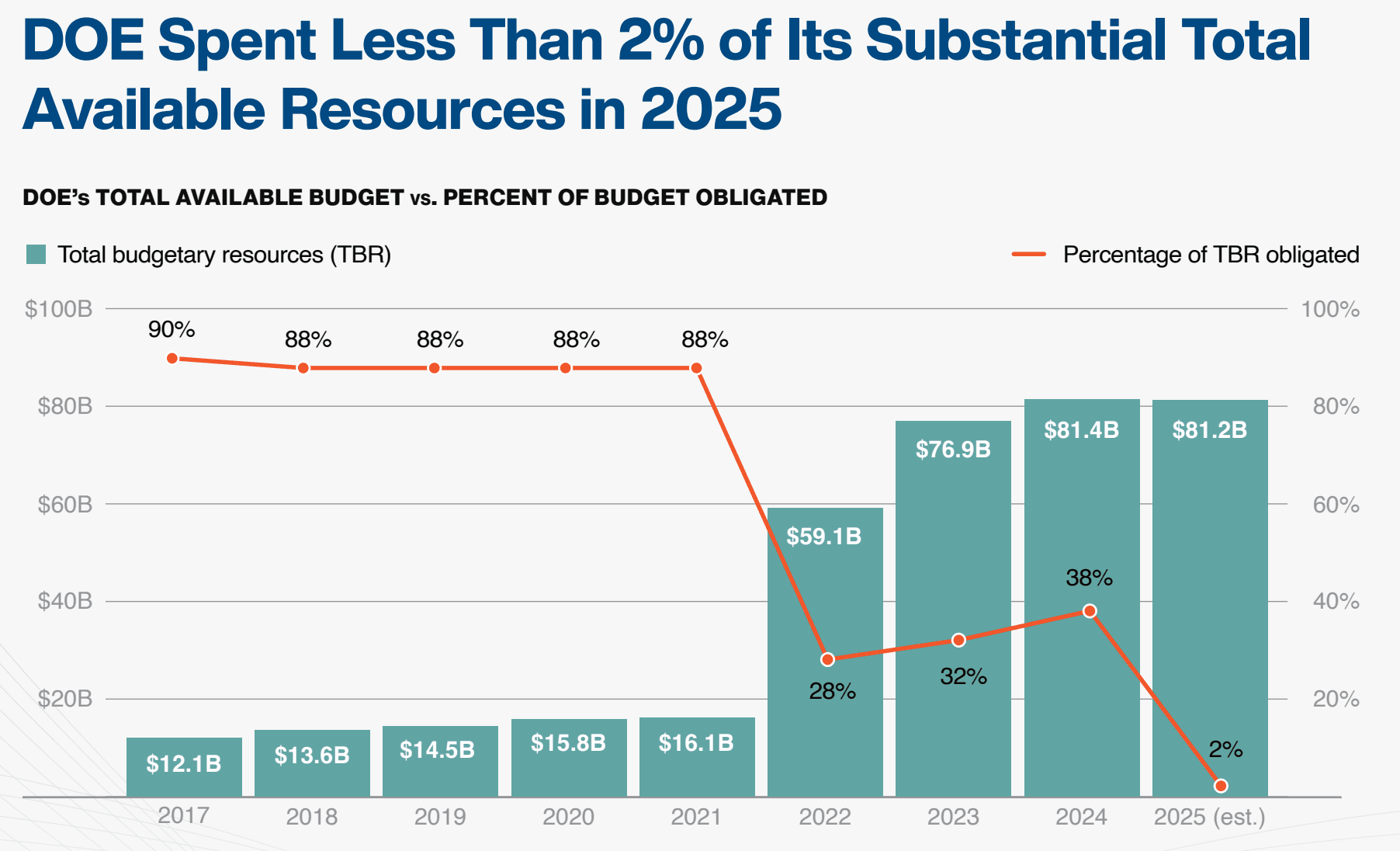
If you've been following U.S. climate and energy news over the past year, you might think this type of work is a sinking ship. The EFI Foundation’s analysis of the DOE’s work in 2025, which we sponsored, shows something close to a complete collapse of the DOE’s obligations. Where the DOE had previously been disbursing on the order of ~$20B annually, 2025 saw that figure drop to roughly ~$1B—a 20x collapse.
A 20x collapse in disbursement should make you think thrice about continuing to invest in a civil society ecosystem seeking to affect the quality of this disbursement. And, indeed, it comes alongside a large amount of similar reporting about how 2025 was a very challenging time for the DOE, with staff cuts, project cancellations, and a near-standstill of new disbursements.
Figure 1. DOE Spent Less than 2% of Its Substantial Total Available Resources in 2025
 Source: EFI Foundation1
If you expect the future of American energy innovation to look like a continuation of 2025, it would make sense to be strongly skeptical about engaging at the federal level. But, does it actually make sense to expect 2026 to look like 2025?
This was a question we pondered in great depth when analyzing whether to renew our investments into American energy innovation civil society in 2026.
The process of answering it gave us room for nuanced optimism about the immediate future of American energy innovation. We have many strong reasons to expect that past ain’t prologue and that we should be on a strongly upwards trajectory. Let’s dive in.
Our investments in civil society supporting American energy innovation
For several years, we’ve been funding U.S. grantees working on energy innovation policy like CATF, DEPLOY/U.S., EFI Foundation, and Clean Tomorrow. Last year, we also deployed $3.5M to establish the Innovation Initiative when Breakthrough Energy collapsed, leaving a critical gap in energy innovation policy advocacy coordination. The Innovation Initiative supports a coalition of organizations that advocate for sustained federal investment in clean energy R&D, demonstration, and deployment. Alongside our upscaling of right-of-center civil society working on energy innovation, this strongly increased our investment in and exposure to the condition of U.S. energy innovation advocacy work.
This year, we had to decide whether or not to continue our investments in this work. The Innovation Initiative supports and coordinates the ecosystem that helped build bipartisan energy innovation funding over the past decade, but their ability to make progress has been constrained by the macro political situation in 2025, when a sequence of largely unforeseen shocks made the political environment dramatically harder than anyone had reason to expect at the start of the year.
What happened in the U.S. in 2025
Two distinct underlying dynamics can explain the collapse of the DOE’s disbursements from ~$20B to ~$1B observed in 2025. To predict what will happen in 2026, we need to understand how these two dynamics interact, their relative importance going forward, and the trajectory for either.
This is a tricky methodological proposition and an inexact science, because we can only observe one U.S. in 2025, and the dynamics co-occur, making strong identification challenging. These two dynamics are:
-
(1) Staffing/capacity constraints: Staff capacity was one of the binding constraints on the DOE's ability to disburse funds in 2025, as the DOGE cuts meant the DOE literally lost the capacity needed to move money out the door. The DOE cut roughly ~3,050 staff (Figure 8) by September 2026. It is clear from anecdotes and examples on and off the record that this has been a constraint in getting money out the door. Even if the administration reverses these staff cuts, there will be a time lag in rehiring and retraining. So, the more weight you give to this explanation, the more pessimistic you might be about the future.
-
(2) Political willingness: In 2025, the Trump administration signaled an unwillingness to fund energy innovation, even aspects that have traditionally been aligned with bipartisan priorities. They canceled or persecuted many Biden-era programs (often dismissed as "Green New Scam" projects) and chose not to elicit proposals and funding requests. The more weight you give to this explanation, the more optimistic you should be when political will changes given one should expect less of a time lag (it takes time to rehire, possibly years, but a change in political will can have quicker consequences).
What we expect to see in the U.S. in 2026 and beyond
Given the inherent uncertainty on the relative importance of each of those drivers, we built three different simple explanatory models exploring different causal mechanisms behind the DOE’s budget, each with different parameterizations and uncertainties.
We then aggregated the findings of these three models to show our best estimate of how much DOE science and energy innovation offices will obligate (i.e., legally commit to spend) in 2026.
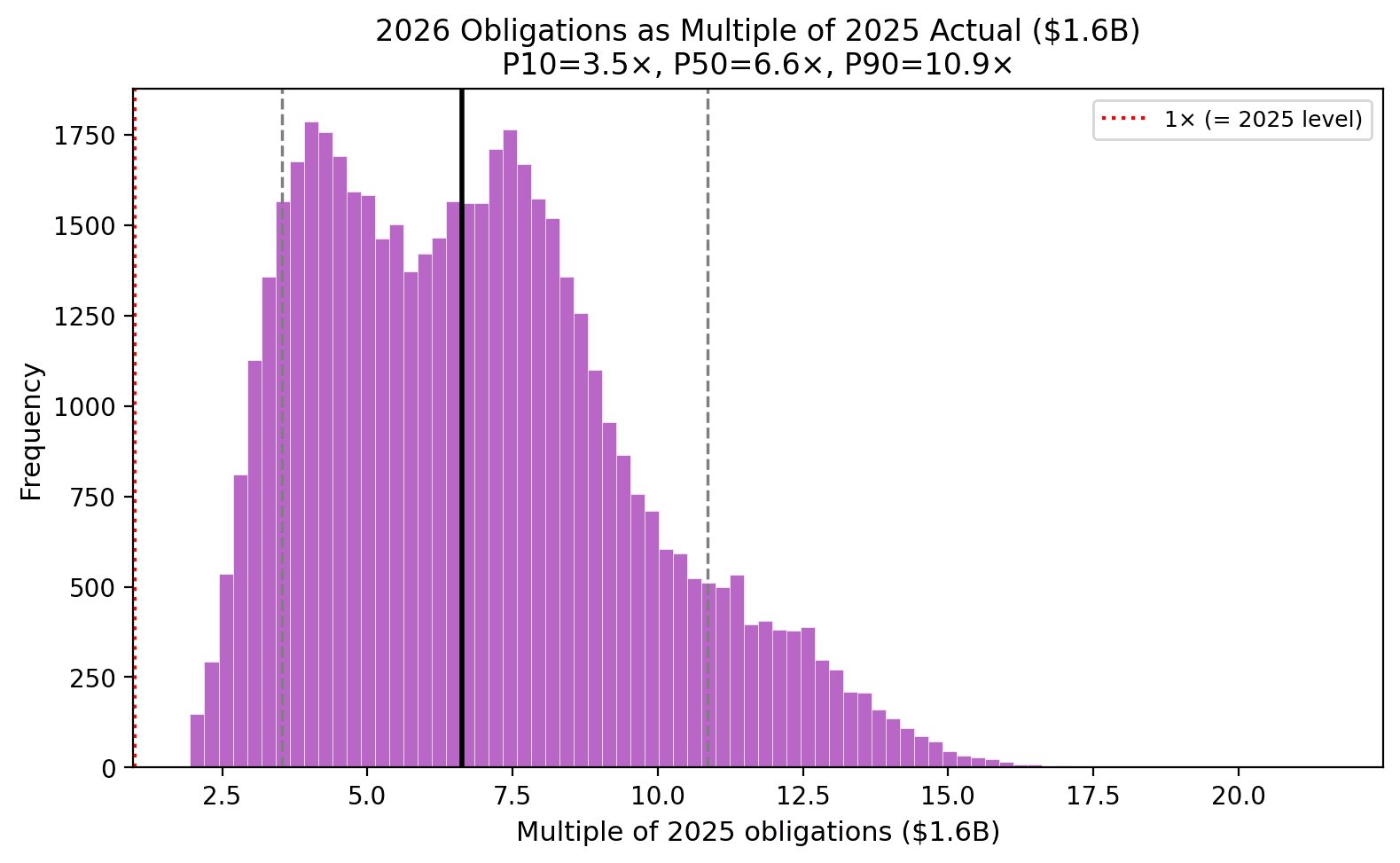
We found the following results:2
Figure 2. 2026 Obligations As Multiple of 2025 Actual ($1.6B)
 Source: Founders Pledge
Note that in these models we have significant uncertainty, and results cover a wide range. Still, even the 10th percentile here is 3x better than 2025 was.
The expectation3 is that the DOE will have about $10.5B of obligations in 2026, which is about half of what it was in the Biden era. In other words, the glass is half-full, but that’s very different from empty. It is clear that we should expect 2026 to be significantly better than 2025. In other words, it would be a grave mistake to over-update on 2025.
Three ways the U.S. picture is changing for the better
While this is a very uncertain estimate and estimates vary by model, the significant up-tick in 2026 expected DOE activity is driven by the two dynamics we described above both having changed significantly. We see this happening in three important ways:
Change #1: The Administration has reversed course on DOE staffing
Looking at the Presidential Budget Request4, it looks as though the Administration is signaling that it wants to reverse course and re-hire among essentially all technology offices and DOE functions it considers relevant for its mission. By our count, DOE signals it would like to increase DOE staff by ~1,000, essentially reversing about ⅓ of the cuts. This would be in line with a DOE that’s more targeted compared to the Biden era, but still fairly muscular.
Hiring is already underway; we already saw in Jan 2026 that DOE-wide hired 56 staff (more than Sep-Dec 2025 combined).
Change #2: The Administration has signaled it wants to now muscularly act on its technology priorities
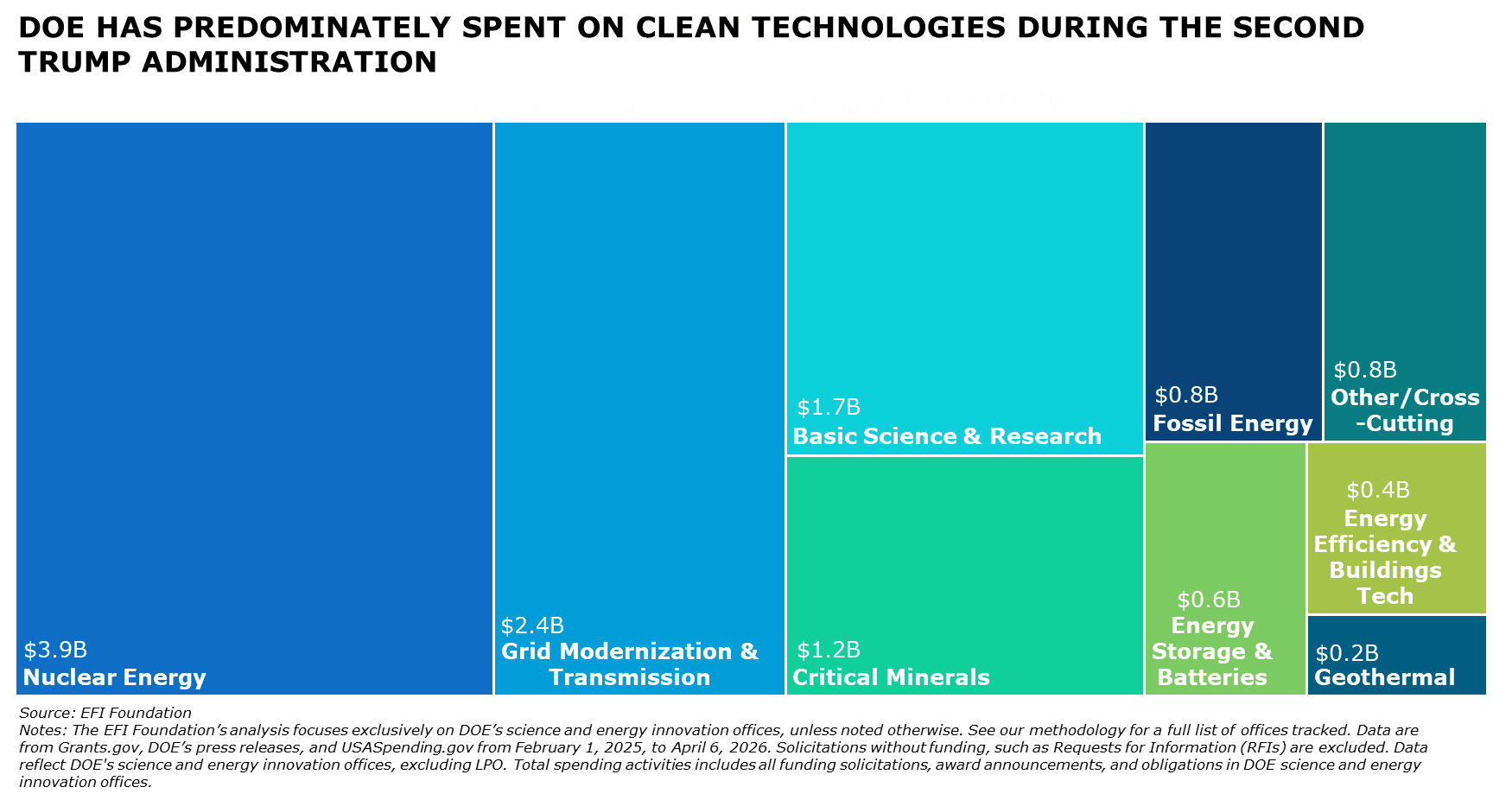
Tracking total DOE spending by the Trump administration’s second term in science and energy innovation (excluding loans) shows a predominant focus on technologies considered to be low-carbon, including nuclear, updating grid infrastructure, critical minerals, and geothermal. Other low-carbon enhancing areas of interest include basic research, energy storage, and energy efficiency.
Figure 3. DOE Has Predominantly Spent on Clean Technologies During the Second Trump Administration (2025–2026)
 Source: EFI Foundation5
Nuclear and geothermal are the key clean firm power bets where successful U.S. innovation could have significant global decarbonization consequences. While this is not the holistic bet on a broad suite of decarbonization technologies the Biden administration was seeking, it is close to what we laid out as the positive case in All In: a vision of energy policy that has significantly decarbonizing consequences even though those aren't the intent.
Change #3: A Congress re-asserting itself reestablishes the prior bipartisan support for energy innovation
Energy innovation funding has been a bipartisan priority in Congress for years. Republican senators from states with national labs, energy research institutions, and clean energy manufacturing have traditionally pushed back against deep DOE cuts, because energy R&D supports jobs and strategic competitiveness in their states. That dynamic was temporarily overwhelmed by the DOGE-driven and an unwillingness by Congress to reign in the Administration as per its traditional role. Now that we're in a more normal legislative environment, those structural politics are reasserting themselves.
These factors, taken together, give us reason for nuanced optimism on the US energy innovation pipeline and they drive the upwards expectation vis-a-vis what we observed for 2025 in our estimates.
Based on our analysis, we’re deploying $5.7M right now to renew our grants to the Innovation Initiative and and we remain open to funding similar work from other grantees as well.
On a meta level, we also think that such analysis shows the importance of moving beyond the headlines and vibes and trying to forecast expectations rather than making funding decisions on last year’s news. When the world changes quickly, past ain’t prologue and what the past tells us about the future requires extrapolation and taking bets, rather than – implicitly or explicitly – assuming that the recent past and future will be very similar.
The next post in this series will turn to our grants in China.
Notes
-
“Total budgetary resources” include DOE’s full obligational authority in a given fiscal year, including appropriations, unobligated carryover balances, and authority from offsetting collections. For the purposes of this analysis, off-budget financing accounts are excluded. “Percent of budgetary resources obligated” is defined as the ratio of the total amount that DOE has contractually committed to paying to total budgetary resources. Data reflect DOE's science and energy innovation offices, excluding LPO. ↩
-
The aggregation shows roughly $5.7B at P10, $10.6B at the median, and $17.4B at P90. The solid black vertical line marks the median (6.6×). The x-axis is expressed as a multiple of the 2025 actual obligation level of $1.6B, so you can read the scale as "how many times larger than 2025 will 2026 spending be?" ↩
-
P50 of 6.6, multiplied by the 2025 baseline of $1.6B. ↩
-
The Presidential Budget Request is a messaging document, not policy, but it gives an important insight into changed priorities. ↩
-
Date are from Grants.gov, DOE’s press releases, and USASpending.gov from February 1, 2025 to April 6, 2026. Solicitations without funding, such as Requests for Information (RFIs) are excluded. Data reflect DOE’s science and energy innovation offices, excluding LPO. Total spending activities includes all funding solicitations, award announcements, and obligations in DOE science and energy innovation offices. ↩