Iran and the Energy Crisis—What Should Climate Philanthropists Do?
Part 1 of 5 in a series explaining the decisions behind the Climate Fund’s first ~$20M of grants in 2026.
Related news
The single most consequential event for global decarbonization this decade likely won’t be a climate policy. Instead, it will almost certainly be the energy crisis triggered by the 2026 closure of the Strait of Hormuz.
The 2022 energy crisis following Russia's invasion of Ukraine is a strong contender for a similar distinction. These were massive shocks to the energy system, with many impacts—one of which is accelerating decarbonization.
When significant new information about the world is revealed, it should prompt a reallocation of effort. We’re already seeing this reallocation in markets, where the price of oil and fossil fuel derivatives is changing dramatically, and the stocks of clean energy companies are rising.
Beyond the information reveal, such a dramatic shift in the energy economy has huge implications for energy policy and, by implication, for almost all interventions climate philanthropists pursue.
It goes without saying that things that are good for the climate can be terrible for the world and that nothing here should be interpreted as optimism about the world more broadly. A regional conflict with great power implications and a global energy crisis with strong recessionary pressures are obviously terrible developments on the whole. But if you're a climate philanthropist trying to allocate capital wisely, you need to understand what this moment means, because it changes the picture significantly.
Here’s how we’re thinking about it.
How have fossil fuel price shocks historically affected decarbonization?
Put somewhat crudely (pun intended), the history of fossil fuel price shocks driving decarbonization policy is very long and quite deep, whereas the history of explicit climate policy doing so is short and shallow.
The most successful domestic decarbonization story, France's nuclear buildout in the 1970s, was driven by the oil crisis, with climate concerns playing no role. Many of the early investments into renewables that paved the way for today's cost curves trace back to the same period. The U.S. launched major solar photovoltaic research programs, Denmark began its pioneering wind turbine projects, and oil companies like Exxon and ARCO invested in solar R&D, all in direct response to the price shocks.
The 2022 energy crisis following Russia's invasion of Ukraine was a major driver of Europe doubling down on decarbonization and also helped the passage of the most significant US climate law in history, the Inflation Reduction Act, which then drove additional catch-up policy in Europe.
With the possible exception of early deployment policies for renewables in the late 1990s and early 2000s, it is difficult to think of climate policies having comparably significant effects. And it is debatable to what degree those were climate policies, given that the most significant one—the German feed-in tariff—was driven primarily by the desire to replace another low-carbon energy source, nuclear, with renewables.
How do we expect the war in Iran to affect climate policy in the short and long term?
The current crisis dwarfs its predecessors.
According to analysis in the New York Times, around 20% of global oil and gas supply is affected, compared to roughly 7% of oil alone during the 1973 embargo. Because both oil and gas are disrupted simultaneously, this represents a more than threefold disruption in terms of primary energy share.
Dependence on oil has luckily decreased by roughly the same factor since the 1970s, so it would be mistaken to assume the shock will be three times worse. But we should expect it to be quite possibly of similar importance and possibly more so depending on how long the crisis persists. Indeed, because we have much more mature low-carbon alternatives available, it would not be unreasonable to expect much stronger decarbonization effects.
Expect accelerated decarbonization on net
A return to coal in some places is unlikely to change the picture enough to offset the broader decarbonizing effects. The reason for this is that—as argued in much more detail in The New Joules Order and subsequent analyses—the overall tilt of focusing on domestic energy resources is towards clean energy.
Replacing gas (fuel-switching) or oil (coal-to-chemical) with coal are the only major actions countries might take in response to this shock that are emissions-increasing, whereas the set of emissions-decreasing actions—from electrifying transport to buying more renewables and storage to building new nuclear—is much broader and more consequential.
Many of the consequences will flow through policy choices and investments that take time to materialize, which means this is a prediction about long-run effects, not necessarily short-term emissions numbers. In the long run, we will look at this as an event that shifted global emissions downwards, possibly significantly so.
Expect different effects across geographies
The effects vary significantly depending on the geography you’re investing in. For example, the U.S. is largely insulated from the natural gas price shock due to domestic supply, while Europe is acutely exposed, and China is positioned to profit as the world’s dominant clean technology exporter. We walk through each region in turn.
United States: muted but positive decarbonization shock
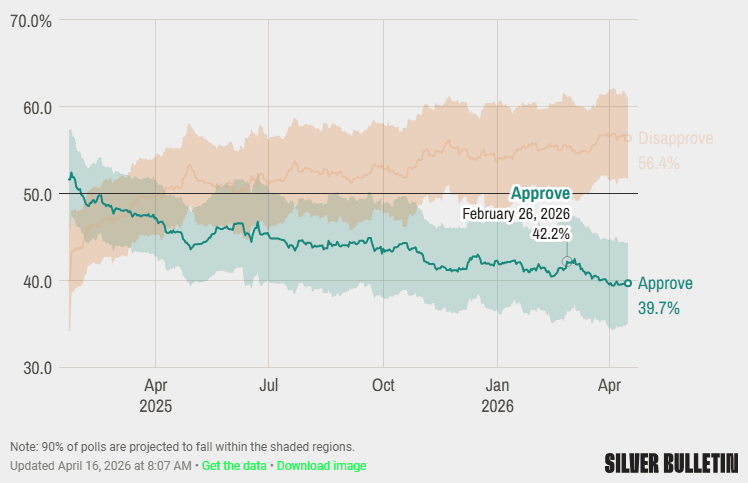
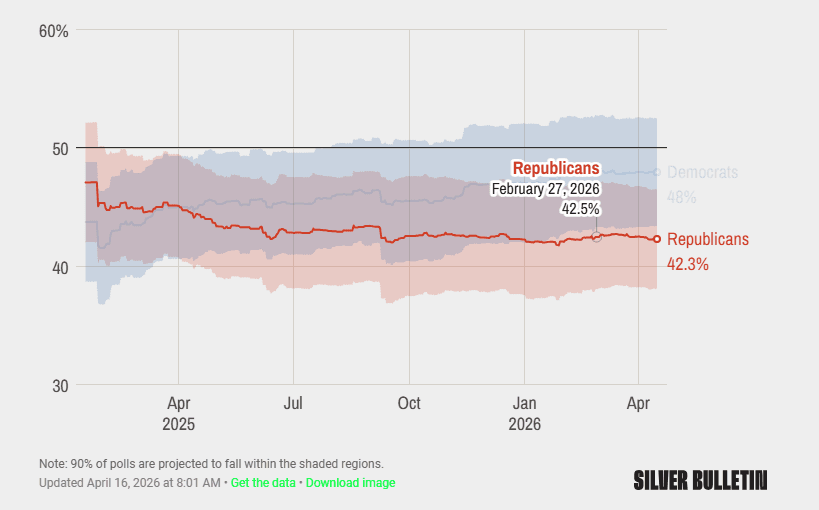
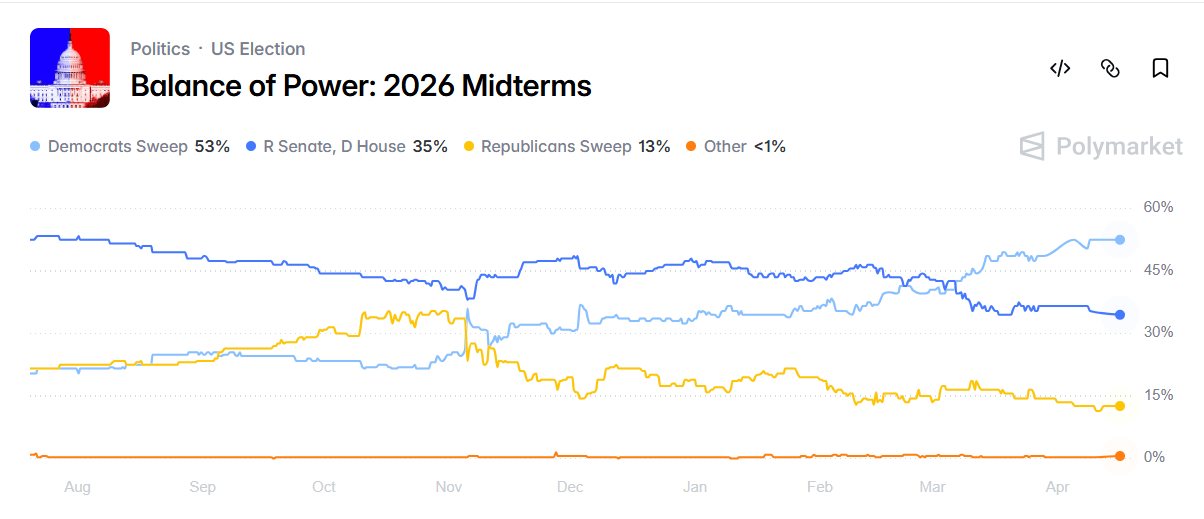
In the U.S., the direct energy price effect is muted because domestic natural gas supply insulates the country from the global LNG shock. The larger effect in the U.S. may be political: the war and its inflationary consequences are driving President Trump's approval to historic lows. Net approval has dropped roughly 5 percentage points since the war began, and the probability that Democrats control both the Senate and House has increased by more than 10%, according to some prediction markets.
Figure 1: Polling of American approval ratings for President Trump
 Source: Silver Bulletin
Figure 2: Probability of Democrats or Republicans winning the race for Congress
 Source: Silver Bulletin
Figure 3: Polling results for the 2026 midterm elections
 Source: Polymarket
This should be good news for U.S. climate policy. Since there’s no climate policy that operates through making (carbon-intensive) energy more expensive in the U.S. at scale, there is little downward pressure to expect on climate-relevant policies. The most significant decarbonization policies all operate through carrots (tax credits, grants, and loans) and they tend to become more politically palpable with increased energy prices.
The main philanthropic implication, we believe, lies in more confidence that Congress will continue to re-assert itself, which de-risks intervention that require stability in appropriations funding and budgets. We will talk about this more in our blog post on the situation in the U.S. later in this series.
Europe: high-variance crossroads
In Europe, the situation is far more acute. Europe depends heavily on liquefied natural gas—with major LNG facilities in Qatar destroyed and roughly 20% of global LNG transiting the Strait of Hormuz—and on oil imports. This crisis therefore hits Europe's electricity, heating, industry, and transport sectors simultaneously, a much more severe shock than in the U.S.
Europe now stands at a crossroads facing contradictory pressures. On the one hand, the crisis puts additional political pressure on carbon pricing and ambitious climate instruments. We see this in Italy's call to suspend the EU ETS (the bloc's flagship emissions trading system), with Slovakia, the Czech Republic, and other member states also pressing to weaken the system in the name of competitiveness.
On the other, it fuels a powerful push toward energy independence, which in Europe means (on net) a focus on decarbonization.
We think the most accurate read is that the Iran crisis makes things overall much more high-variance in Europe, with both a severe backlash and a doubling down on decarbonization becoming more likely. The net first-order effect of the last fossil fuel price shock (the Ukraine invasion) was Europe doubling down. But, arguably, the inflationary environment and energy crisis contributed to the climate backlash in the 2024 European Parliament elections. An anti-incumbent sentiment could propel more climate-skeptical parties into power in important Member State elections in 2027.
China: cleantech export machine
As the dominant manufacturer of almost all mature clean technologies—producing roughly 80% of the world's solar panels and battery cells—China's export sector is positioned to absorb a surge in global demand for alternatives to fossil fuel dependence. When countries' fossil fuel supply is disrupted and prices spike, the cheapest available path to reduced vulnerability is Chinese solar, batteries, and EVs.
This was already happening before the Strait of Hormuz closure. China's cleantech exports hit a record $20 billion in a single month in August 2025. In Q1 2026, Chinese EV exports surged 77.5% year-on-year, lithium battery exports jumped 50%, and wind turbine exports rose 45%, according to official customs data. The crisis in Iran began in March, so these figures likely understate the trajectory, and we expect Q2 data to be even more dramatic.
In some sense, because the decarbonizing effect of the crisis flowing through China's cleantech export machine has already been happening, it seems unlikely that philanthropy could make a large marginal difference to its pace. The more philanthropically interesting questions about China concern whether it will go beyond technologies of existing strength to also contribute to frontier challenges like industrial decarbonization and coal plant retrofitting, questions we’ll address in a later post in this series.
Emerging and developing economies
In global markets, what are price shocks for the rich are supply shortages for the poor. Poorer Asian economies as well as many economies in Africa will bear the biggest humanitarian costs of the energy crisis, as richer economies divert a scarcer fossil fuel supply to their ports.
But the strength of this supply shock should also lead us to expect that the interest in reducing future vulnerability will be starkest in those countries, and that this will meaningfully increase their demand for solar, wind, and batteries as the quickest and cheapest strategies to reduce fossil fuel dependence in the near term.
Pakistan is a striking example. The 2022 energy crisis, when electricity bills jumped by up to 200% and coal import costs hit $419 per tonne, triggered a solar revolution that state energy policy had failed to deliver for decades, when Pakistani consumers and businesses turned en masse to rooftop solar and battery storage.
The current crisis will almost certainly deepen and broaden this pattern. Countries across South and Southeast Asia that are heavily exposed to fossil fuel import costs face a powerful economic incentive to accelerate their own transitions.
How has the Climate Fund responded?
This macro picture—accelerated decarbonization on net, but with sharply divergent effects across geographies and a particularly contested moment in Europe—is the backdrop against which we’re deploying our first ~$20M in grants in the first half of 2026.
We should be clear that not everything about these grants is related to current events. While the blog post series focuses on analyzing this moment and how the grants relate to this moment, our grants were not fully contingent on these changes.
When choosing our grants, we focus on pivotalness: we focus our resources where outcomes are genuinely uncertain, where competing pressures mean things could go either way, and where philanthropic capital can help tip the balance.
In the next posts in this series, we'll walk through our recent grants in detail: why this is a pivotal moment for European climate policy, why we're doubling down on U.S. energy innovation under an administration that's evolving faster than most observers expected, and how we are working in China. We’ll also step back and lay out a broader framework for how climate philanthropists should think about reacting to world events: when to update, what pivotalness means in practice, and why philanthropy’s structural slowness creates opportunity for those willing to move.