Welcoming Dr. Libbie Prescott: Global Catastrophic Risks Lead
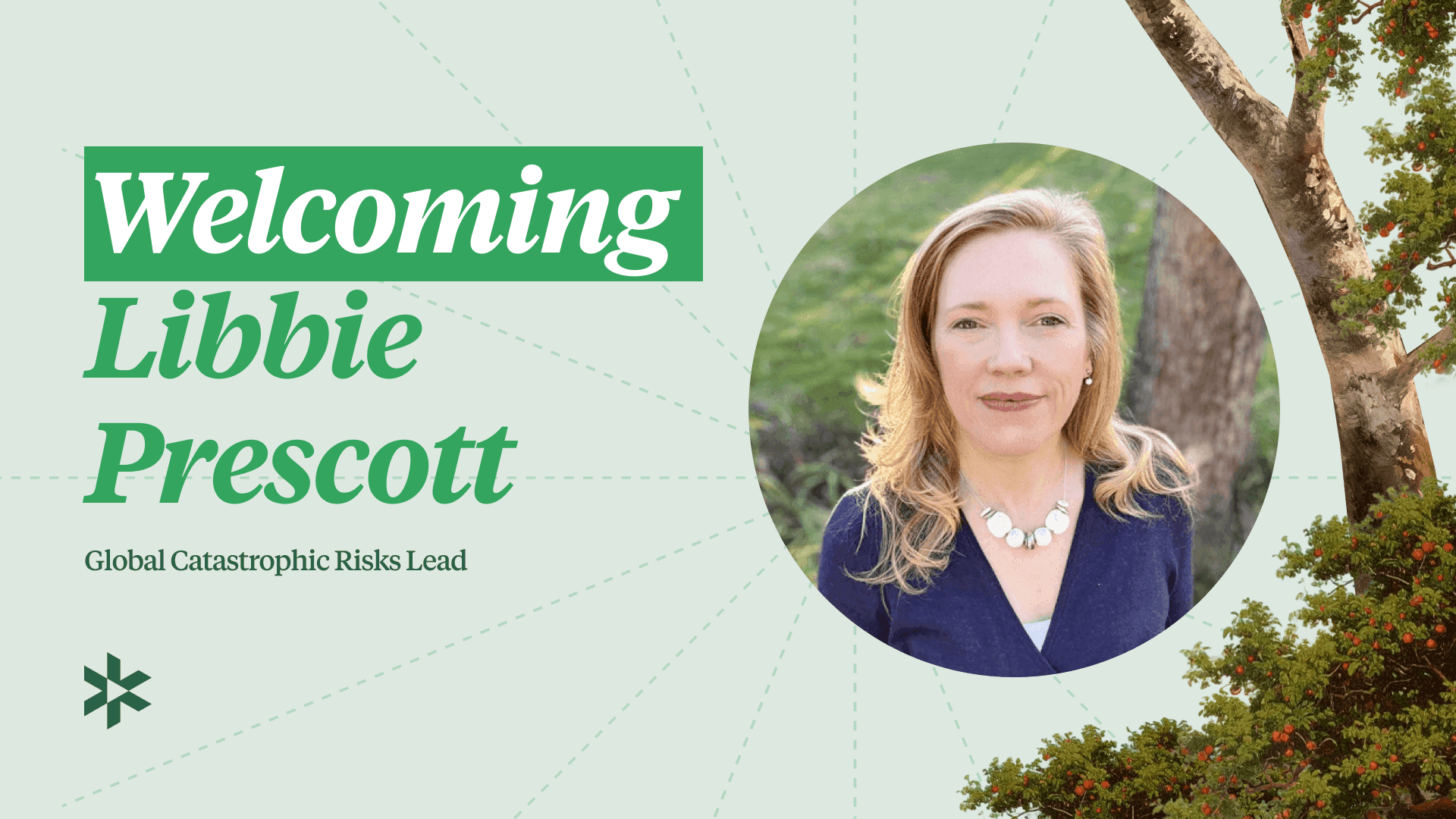
We're thrilled to introduce Dr. Libbie Prescott, who’s joined Founders Pledge as our new Cause Lead for the Global Catastrophic Risks (GCR) Program.
With her unique blend of scientific expertise and policy experience spanning multiple US government agencies, Capitol Hill, and civil society, Libbie is perfectly positioned to lead our GCR work through a period of rapid technological change and geopolitical disruption.
Bridging Science and Strategy
Libbie has spent much of her career working at the intersection of emerging technologies and global governance.
She holds a doctorate in molecular biology from Oxford’s Balliol College and brings deep technical understanding to questions that too often get treated as purely political or abstract. She’s also translated her scientific training into real-world impact—as a US diplomat, faculty member at Georgetown's School of Foreign Service, and program director at the US National Academies.
Libbie brings a rare ability to evaluate geopolitical constraints and institutional capacity, stress-test assumptions and timelines, and assess where our work can make a disproportionate impact.
“I believe we can responsibly navigate societal transformation whether caused by technologies or geopolitics—but only if we act with foresight and clarity before crises emerge,” Libbie writes. “That means building smart institutions, better governance, and long-term thinking today.”
The Next Chapter for GCR
Founders Pledge takes a philanthropic approach that doesn't just fund interventions in isolation, but actively shapes the ecosystem by catalyzing new collaborations or building capacity where it doesn't yet exist.
Our GCR program will continue to focus on great power competition, AI safety, biosecurity, and nuclear risk while also exploring emerging areas that we believe could meaningfully protect humanity. As Libbie settles into her role, she's working with the team to both deepen our work in established areas and actively pursue new opportunities that don't yet exist in the philanthropic landscape.
Recent grants from the GCR Fund have addressed global issues that include:
- Nuclear de-escalation and resilience. As nuclear risk resurges, we will continue to invest in understanding how to deescalate and terminate war, which is even more critical now as deterrence continues to erode. We recently co-designed a project with the American Enterprise Institute (AEI) to tackle nuclear war termination through research and policy advocacy.
- Building and scaling safeguards for transformative AI. Advancing AI capabilities require new models of governance, and we are working to catalyze both top-down and bottom-up solutions, including new backchannel diplomacy and safety community led self-governance. We’ve worked with grantees like the Carnegie Endowment for International Peace (CEIP) and the Center for Responsible Innovation (CRI) to support their work on AI safety risks.
- Strengthening resilience to AI-enabled biological design. The changing technical landscape needs new models for biosecurity response and international coordination that mitigate biosecurity threats. We’ve worked with grantees like SecureBio to develop technologies and policies that protect the world against extreme biological risks.
- Addressing systemic hurdles to global security. Many of our grants don't just fund specific projects—they fill gaps or build infrastructure to enable more sustained cooperation or reduce friction that allows for increased impact. Most recently, we established the Conclave on Great Powers and Extreme Risks, a venue for coordination and shared best practices among backchannel diplomats to increase the impact across many programs rather than funding just one.
We're grateful to have Libbie's expertise and strategic thinking leading our GCR efforts through this critical period. Libbie’s role will increasingly shape how Founders Pledge approaches emerging risks and pioneer our strategies for new areas of impact.
The GCR Fund is supported by donors who understand that preventing catastrophe requires acting now, before urgency replaces strategy. If you're interested in learning more about our work or supporting the program, you can learn more about the Global Catastrophic Risks Fund or get in touch to discuss how you can support this crucial work.
